

Summary
I led the app install ads team to develop Facebook’s first interactive News Feed ad format: Playable Ads. Partnering closely with engineering, I designed, tested, and built the Playable experience from 0 to 1, delivering both an engaging user experience and a powerful new tool for advertisers. Through rapid iteration and ongoing user research, I drove Playable Ads from early concepts to launch, then broadened the format to additional advertiser verticals and placements. The design patterns created for Playable Ads were subsequently reused across multiple ad products, leaving a lasting mark on Meta’s ad ecosystem.
Problem statement

On average people download very few new apps every month
average number of apps people use every month
of revenue comes from 1-2% of players in mobile games
Very few people download new apps, which creates real risk for app install advertisers and game developers. Ad blindness is already high, roughly 1 in 100 people click on an ad, and app install ads face an extra hurdle because conversion requires a download. Many Facebook users say they avoid new apps to save phone storage or data.
Yet we also know that users often keep playing paid acquisition games for days or weeks, and many discover their favorite apps through app install ads. Because most game developers generate the bulk of their revenue from their most engaged players, connecting these enthusiastic players with the right games is critical to the business.
My contribution
I provided strategic leadership for the app install ads team by prototyping, testing, and building the consumer and advertiser experiences for HTML interactive Playable Ads. Through extensive user research and iterative design, I shaped a first-of-its-kind interactive format that was highly engaging yet not disruptive to the News Feed experience. Leveraging both research insights and performance data, I persuaded the highly risk-averse News Feed team to approve the launch and subsequent expansion of Playable Ads. In parallel, I designed the full suite of advertiser-facing tools that allowed partners to test and refine how HTML5 games looked and felt on Facebook and off-platform.
App install ads team

Design lead

2 Researchers

Content strategist

2 Product managers

Eng manager

13 Engineers

2 Product marketing managers
Outcome & Impact

1.4x to 3.2x improvement in ROAS
Reduction in cost of acquiring new users
exceeded of revenue goal when launched
Playable Ads created a win–win: people could try games and download only if they enjoyed the experience, while advertisers gained highly motivated players. During beta, the format generated dramatic ROAS gains, reduced the cost of acquiring new players, and drove a substantial increase in advertiser spend. On the strength of these results, Playable Ads moved rapidly from beta to full launch, and we expanded the format across more placements, including Stories, off-platform inventory, non-gaming advertisers, and even non–app install objectives.
Playable ads experience for users
Playable Ads are HTML5, bite-sized game experiences that function as demos or previews, giving people a quick taste of gameplay so they can decide if they’ll enjoy a title before installing it. Prior research indicated that about 80% of users are low-intent explorers, while 20% are high-intent and know exactly what they want, often downloading directly from the call-to-action (CTA). I designed the experience to respect this split: a prominent CTA supported high-intent users, while a safe, low-friction interactive demo supported low-intent explorers.
When someone entered a Playable experience, they could easily back out without leaving the Facebook app. We monitored this behavior closely to ensure that Playable Ads did not degrade the broader Facebook experience. I combined quantitative usage data with qualitative research to calibrate an experience that was immersive and compelling, yet always offered a clear and effortless way to opt out.
Once we confirmed that Playables delivered strong performance gains without negatively affecting usage metrics, we expanded the format beyond gaming app installs to other app categories and then to additional ad objectives. The opt-out design pattern, proven safe for core engagement metrics, was also adopted in other placements, including Stories, interstitials, and off-platform Audience Network inventory.
Newsfeed overlay
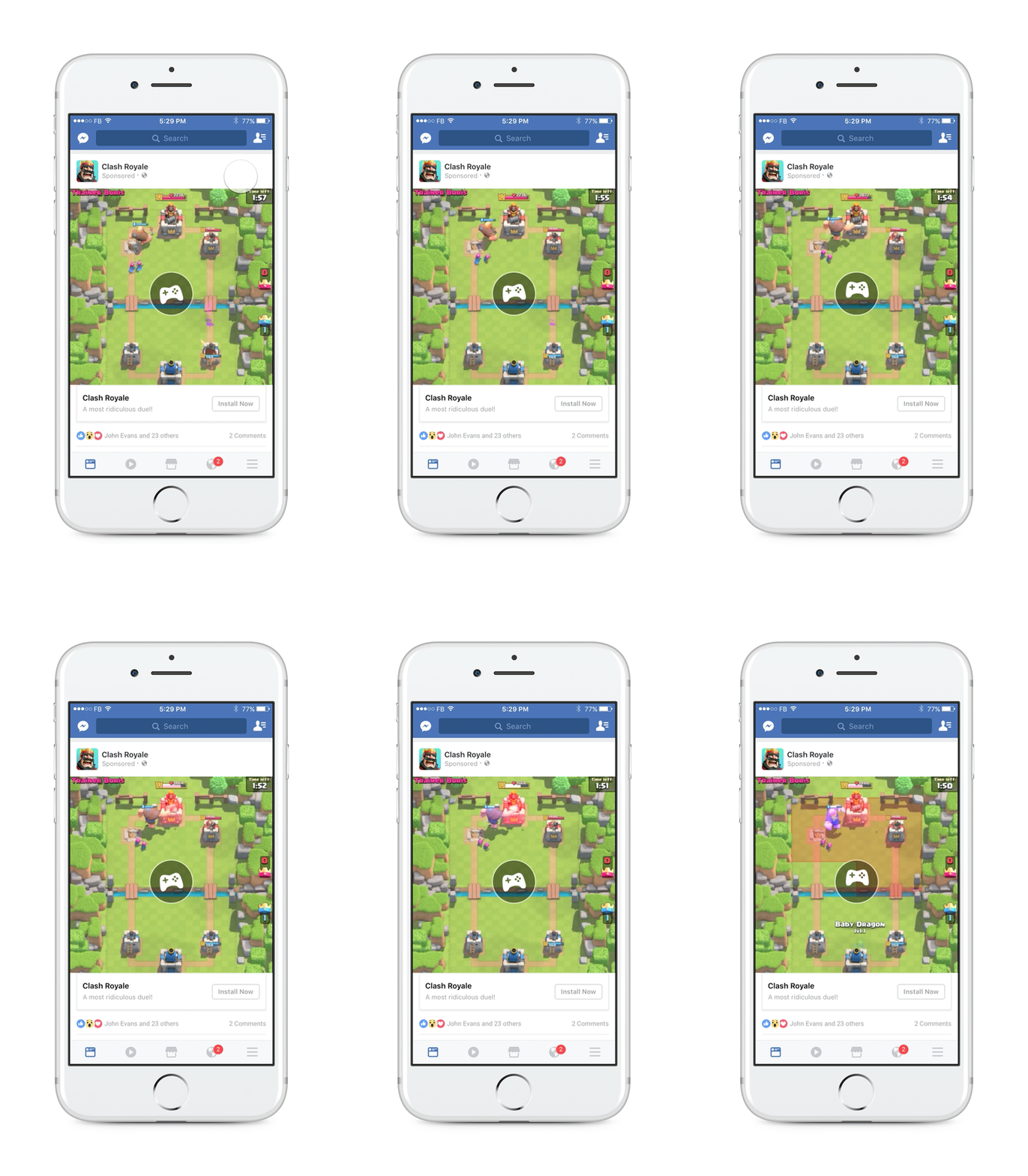
Creating an interactive ad experience within Facebook’s already interactive News Feed was the core challenge. My goal was a two-step flow: present the ad creative with a distinct visual marker, then use that marker to transition users into an immersive Playable experience. I explored a broad set of design directions, and user research helped us converge on two key elements: a game controller icon and a text label. I merged these by having the icon and label alternate within an overlay on the News Feed unit. To support discovery, I also designed a first-time-use tooltip that introduced the format. Together, the icon and label were both engaging and clear, so users understood what would happen when they clicked into the Playable.
Playable wrapper
When users clicked a Playable creative, they remained in the Facebook app but entered a full-page experience. Research made it clear that we needed to reassure people they weren’t being redirected to an unfamiliar or unsafe browser, and that they retained full control to opt out at any time. To address this, we kept a prominent Facebook-colored header at the top of the experience, which consistently signaled that they were still within the app and could back out whenever they wanted.
Loading state
Because Playables could take 1–3 seconds to load, I designed and tested multiple loading states to keep users engaged. The most effective solution was to reuse the full-screen video player controls, which made it feel like users were just watching a video while the Playable demo loaded behind the scenes. Over time, we began preloading Playable content for qualified users, so by launch there was effectively no visible loading experience.
Advertisers experience
While I was designing the consumer experience, I also built an advertiser module for uploading and testing Playable Ads. Because traditional Playables, especially those injected into mobile games, rarely included an opt-out, it was essential that advertisers could preview the entire user journey. The tool allowed them to see the News Feed placement, click into and play the game, and then proceed to the app store, mirroring the real end-to-end flow. Based on lessons from earlier tests, I also required advertisers to play through and complete their own Playable so they could validate the experience and confirm that a native CTA was present and effective.
Outcomes
Impact
Playable Ads created a win–win: people could try games and download only if they enjoyed the experience, while advertisers gained highly motivated players. During beta, the format generated dramatic ROAS gains, reduced the cost of acquiring new players, and drove a substantial increase in advertiser spend. On the strength of these results, Playable Ads moved rapidly from beta to full launch, and we expanded the format across more placements, including Stories, off-platform inventory, non-gaming advertisers, and even non–app install objectives.
exceeded of revenue goal when launched
Reduction in cost of acquiring new users
1.4x to 3.2x improvement in ROAS
User research & personal learnings
Users generally trusted the Facebook app, and that trust shaped our design choices. My original plan was to make the Playable experience fully immersive, but research participants clearly preferred seeing familiar Facebook elements that reassured them they hadn’t been redirected to a malicious web page.
In early experiments, Playables underperformed relative to control ads and were at real risk of being shut down. By combining deep user research with fast development and iteration, we uncovered key usability and trust issues in the flow and systematically addressed them. Over time, these improvements turned Playables into one of the highest-performing ad formats in our portfolio.

Currently viewing
Skype
MICROSOFT
B2C
B2B
Mobile
Experimental
2015
Fire Phone
Amazon
B2C
Mobile
0-1
Experimental
2014
INRIX
INRIX
B2B
B2C
Mobile
0-1
2013
Sales Coaching
Lead
AI
0-1
Sales CRM
2025
Sales Assistant
Lead
AI
0-1
Sales CRM
2024
Customer Authentication
Lead
B2B
B2C
Security
2023
Workforce Automation
Lead
B2B
Big Data
2022
Collaborative Stories
META
Lead
B2C
Mobile
2020
Smart App Promotions
META
Lead
B2B
Ads
Automation
0-1
2019
Summary
I led the app install ads team to develop Facebook’s first interactive News Feed ad format: Playable Ads. Partnering closely with engineering, I designed, tested, and built the Playable experience from 0 to 1, delivering both an engaging user experience and a powerful new tool for advertisers. Through rapid iteration and ongoing user research, I drove Playable Ads from early concepts to launch, then broadened the format to additional advertiser verticals and placements. The design patterns created for Playable Ads were subsequently reused across multiple ad products, leaving a lasting mark on Meta’s ad ecosystem.
Problem statement
On average people download very few new apps every month
average number of apps people use every month
of revenue comes from 1-2% of players in mobile games
Very few people download new apps, which creates real risk for app install advertisers and game developers. Ad blindness is already high, roughly 1 in 100 people click on an ad, and app install ads face an extra hurdle because conversion requires a download. Many Facebook users say they avoid new apps to save phone storage or data.
Yet we also know that users often keep playing paid acquisition games for days or weeks, and many discover their favorite apps through app install ads. Because most game developers generate the bulk of their revenue from their most engaged players, connecting these enthusiastic players with the right games is critical to the business.
My contribution
I provided strategic leadership for the app install ads team by prototyping, testing, and building the consumer and advertiser experiences for HTML interactive Playable Ads. Through extensive user research and iterative design, I shaped a first-of-its-kind interactive format that was highly engaging yet not disruptive to the News Feed experience. Leveraging both research insights and performance data, I persuaded the highly risk-averse News Feed team to approve the launch and subsequent expansion of Playable Ads. In parallel, I designed the full suite of advertiser-facing tools that allowed partners to test and refine how HTML5 games looked and felt on Facebook and off-platform.
App install ads team
Design lead
2 Researchers
Content strategist
2 Product managers

Eng manager

13 Engineers

2 Product marketing managers
Outcome & Impact
1.4x to 3.2x improvement in ROAS
Reduction in cost of acquiring new users
exceeded of revenue goal when launched
Playable Ads created a win–win: people could try games and download only if they enjoyed the experience, while advertisers gained highly motivated players. During beta, the format generated dramatic ROAS gains, reduced the cost of acquiring new players, and drove a substantial increase in advertiser spend. On the strength of these results, Playable Ads moved rapidly from beta to full launch, and we expanded the format across more placements, including Stories, off-platform inventory, non-gaming advertisers, and even non–app install objectives.
Playable ads experience for users
Playable Ads are HTML5, bite-sized game experiences that function as demos or previews, giving people a quick taste of gameplay so they can decide if they’ll enjoy a title before installing it. Prior research indicated that about 80% of users are low-intent explorers, while 20% are high-intent and know exactly what they want, often downloading directly from the call-to-action (CTA). I designed the experience to respect this split: a prominent CTA supported high-intent users, while a safe, low-friction interactive demo supported low-intent explorers.
When someone entered a Playable experience, they could easily back out without leaving the Facebook app. We monitored this behavior closely to ensure that Playable Ads did not degrade the broader Facebook experience. I combined quantitative usage data with qualitative research to calibrate an experience that was immersive and compelling, yet always offered a clear and effortless way to opt out.
Once we confirmed that Playables delivered strong performance gains without negatively affecting usage metrics, we expanded the format beyond gaming app installs to other app categories and then to additional ad objectives. The opt-out design pattern, proven safe for core engagement metrics, was also adopted in other placements, including Stories, interstitials, and off-platform Audience Network inventory.
Newsfeed overlay
Creating an interactive ad experience within Facebook’s already interactive News Feed was the core challenge. My goal was a two-step flow: present the ad creative with a distinct visual marker, then use that marker to transition users into an immersive Playable experience. I explored a broad set of design directions, and user research helped us converge on two key elements: a game controller icon and a text label. I merged these by having the icon and label alternate within an overlay on the News Feed unit. To support discovery, I also designed a first-time-use tooltip that introduced the format. Together, the icon and label were both engaging and clear, so users understood what would happen when they clicked into the Playable.
Playable wrapper
When users clicked a Playable creative, they remained in the Facebook app but entered a full-page experience. Research made it clear that we needed to reassure people they weren’t being redirected to an unfamiliar or unsafe browser, and that they retained full control to opt out at any time. To address this, we kept a prominent Facebook-colored header at the top of the experience, which consistently signaled that they were still within the app and could back out whenever they wanted.
Loading state
Because Playables could take 1–3 seconds to load, I designed and tested multiple loading states to keep users engaged. The most effective solution was to reuse the full-screen video player controls, which made it feel like users were just watching a video while the Playable demo loaded behind the scenes. Over time, we began preloading Playable content for qualified users, so by launch there was effectively no visible loading experience.
Advertisers experience
While I was designing the consumer experience, I also built an advertiser module for uploading and testing Playable Ads. Because traditional Playables, especially those injected into mobile games, rarely included an opt-out, it was essential that advertisers could preview the entire user journey. The tool allowed them to see the News Feed placement, click into and play the game, and then proceed to the app store, mirroring the real end-to-end flow. Based on lessons from earlier tests, I also required advertisers to play through and complete their own Playable so they could validate the experience and confirm that a native CTA was present and effective.
Outcomes
Impact
Playable Ads created a win–win: people could try games and download only if they enjoyed the experience, while advertisers gained highly motivated players. During beta, the format generated dramatic ROAS gains, reduced the cost of acquiring new players, and drove a substantial increase in advertiser spend. On the strength of these results, Playable Ads moved rapidly from beta to full launch, and we expanded the format across more placements, including Stories, off-platform inventory, non-gaming advertisers, and even non–app install objectives.
exceeded of revenue goal when launched
Reduction in cost of acquiring new users
1.4x to 3.2x improvement in ROAS
User research & personal learnings
Users generally trusted the Facebook app, and that trust shaped our design choices. My original plan was to make the Playable experience fully immersive, but research participants clearly preferred seeing familiar Facebook elements that reassured them they hadn’t been redirected to a malicious web page.
In early experiments, Playables underperformed relative to control ads and were at real risk of being shut down. By combining deep user research with fast development and iteration, we uncovered key usability and trust issues in the flow and systematically addressed them. Over time, these improvements turned Playables into one of the highest-performing ad formats in our portfolio.
Currently viewing
Skype
MICROSOFT
B2C
B2B
Mobile
Experimental
2015
Fire Phone
Amazon
B2C
Mobile
0-1
Experimental
2014
INRIX
INRIX
B2B
B2C
Mobile
0-1
2013
Sales Coaching
Lead
AI
0-1
Sales CRM
2025
Sales Assistant
Lead
AI
0-1
Sales CRM
2024
Customer Authentication
Lead
B2B
B2C
Security
2023
Workforce Automation
Lead
B2B
Big Data
2022
Collaborative Stories
META
Lead
B2C
Mobile
2020
Smart App Promotions
META
Lead
B2B
Ads
Automation
0-1
2019
Summary
I led the app install ads team to develop Facebook’s first interactive News Feed ad format: Playable Ads. Partnering closely with engineering, I designed, tested, and built the Playable experience from 0 to 1, delivering both an engaging user experience and a powerful new tool for advertisers. Through rapid iteration and ongoing user research, I drove Playable Ads from early concepts to launch, then broadened the format to additional advertiser verticals and placements. The design patterns created for Playable Ads were subsequently reused across multiple ad products, leaving a lasting mark on Meta’s ad ecosystem.
Problem statement
On average people download very few new apps every month
average number of apps people use every month
of revenue comes from 1-2% of players in mobile games
Very few people download new apps, which creates real risk for app install advertisers and game developers. Ad blindness is already high, roughly 1 in 100 people click on an ad, and app install ads face an extra hurdle because conversion requires a download. Many Facebook users say they avoid new apps to save phone storage or data.
Yet we also know that users often keep playing paid acquisition games for days or weeks, and many discover their favorite apps through app install ads. Because most game developers generate the bulk of their revenue from their most engaged players, connecting these enthusiastic players with the right games is critical to the business.
My contribution
I provided strategic leadership for the app install ads team by prototyping, testing, and building the consumer and advertiser experiences for HTML interactive Playable Ads. Through extensive user research and iterative design, I shaped a first-of-its-kind interactive format that was highly engaging yet not disruptive to the News Feed experience. Leveraging both research insights and performance data, I persuaded the highly risk-averse News Feed team to approve the launch and subsequent expansion of Playable Ads. In parallel, I designed the full suite of advertiser-facing tools that allowed partners to test and refine how HTML5 games looked and felt on Facebook and off-platform.
App install ads team
Design lead
2 Researchers
Content strategist
2 Product managers
Eng manager
13 Engineers
2 Product marketing managers
Outcome & Impact
1.4x to 3.2x improvement in ROAS
Reduction in cost of acquiring new users
exceeded of revenue goal when launched
Playable Ads created a win–win: people could try games and download only if they enjoyed the experience, while advertisers gained highly motivated players. During beta, the format generated dramatic ROAS gains, reduced the cost of acquiring new players, and drove a substantial increase in advertiser spend. On the strength of these results, Playable Ads moved rapidly from beta to full launch, and we expanded the format across more placements, including Stories, off-platform inventory, non-gaming advertisers, and even non–app install objectives.
Playable ads experience for users
Playable Ads are HTML5, bite-sized game experiences that function as demos or previews, giving people a quick taste of gameplay so they can decide if they’ll enjoy a title before installing it. Prior research indicated that about 80% of users are low-intent explorers, while 20% are high-intent and know exactly what they want, often downloading directly from the call-to-action (CTA). I designed the experience to respect this split: a prominent CTA supported high-intent users, while a safe, low-friction interactive demo supported low-intent explorers.
When someone entered a Playable experience, they could easily back out without leaving the Facebook app. We monitored this behavior closely to ensure that Playable Ads did not degrade the broader Facebook experience. I combined quantitative usage data with qualitative research to calibrate an experience that was immersive and compelling, yet always offered a clear and effortless way to opt out.
Once we confirmed that Playables delivered strong performance gains without negatively affecting usage metrics, we expanded the format beyond gaming app installs to other app categories and then to additional ad objectives. The opt-out design pattern, proven safe for core engagement metrics, was also adopted in other placements, including Stories, interstitials, and off-platform Audience Network inventory.
Newsfeed overlay
Creating an interactive ad experience within Facebook’s already interactive News Feed was the core challenge. My goal was a two-step flow: present the ad creative with a distinct visual marker, then use that marker to transition users into an immersive Playable experience. I explored a broad set of design directions, and user research helped us converge on two key elements: a game controller icon and a text label. I merged these by having the icon and label alternate within an overlay on the News Feed unit. To support discovery, I also designed a first-time-use tooltip that introduced the format. Together, the icon and label were both engaging and clear, so users understood what would happen when they clicked into the Playable.
Playable wrapper
When users clicked a Playable creative, they remained in the Facebook app but entered a full-page experience. Research made it clear that we needed to reassure people they weren’t being redirected to an unfamiliar or unsafe browser, and that they retained full control to opt out at any time. To address this, we kept a prominent Facebook-colored header at the top of the experience, which consistently signaled that they were still within the app and could back out whenever they wanted.
Loading state
Because Playables could take 1–3 seconds to load, I designed and tested multiple loading states to keep users engaged. The most effective solution was to reuse the full-screen video player controls, which made it feel like users were just watching a video while the Playable demo loaded behind the scenes. Over time, we began preloading Playable content for qualified users, so by launch there was effectively no visible loading experience.
Advertisers experience
While I was designing the consumer experience, I also built an advertiser module for uploading and testing Playable Ads. Because traditional Playables, especially those injected into mobile games, rarely included an opt-out, it was essential that advertisers could preview the entire user journey. The tool allowed them to see the News Feed placement, click into and play the game, and then proceed to the app store, mirroring the real end-to-end flow. Based on lessons from earlier tests, I also required advertisers to play through and complete their own Playable so they could validate the experience and confirm that a native CTA was present and effective.
Outcomes
Impact
Playable Ads created a win–win: people could try games and download only if they enjoyed the experience, while advertisers gained highly motivated players. During beta, the format generated dramatic ROAS gains, reduced the cost of acquiring new players, and drove a substantial increase in advertiser spend. On the strength of these results, Playable Ads moved rapidly from beta to full launch, and we expanded the format across more placements, including Stories, off-platform inventory, non-gaming advertisers, and even non–app install objectives.
exceeded of revenue goal when launched
Reduction in cost of acquiring new users
1.4x to 3.2x improvement in ROAS
User research & personal learnings
Users generally trusted the Facebook app, and that trust shaped our design choices. My original plan was to make the Playable experience fully immersive, but research participants clearly preferred seeing familiar Facebook elements that reassured them they hadn’t been redirected to a malicious web page.
In early experiments, Playables underperformed relative to control ads and were at real risk of being shut down. By combining deep user research with fast development and iteration, we uncovered key usability and trust issues in the flow and systematically addressed them. Over time, these improvements turned Playables into one of the highest-performing ad formats in our portfolio.
Currently viewing
Skype
MICROSOFT
B2C
B2B
Mobile
Experimental
2015
Fire Phone
Amazon
B2C
Mobile
0-1
Experimental
2014
INRIX
INRIX
B2B
B2C
Mobile
0-1
2013
Sales Coaching
Lead
AI
0-1
Sales CRM
2025
Sales Assistant
Lead
AI
0-1
Sales CRM
2024
Customer Authentication
Lead
B2B
B2C
Security
2023
Workforce Automation
Lead
B2B
Big Data
2022
Collaborative Stories
META
Lead
B2C
Mobile
2020
Smart App Promotions
META
Lead
B2B
Ads
Automation
0-1
2019